
Explore Our
Perspectives
Deep dives into technology, career growth, and the future of work. Written by our experts and industry leaders.
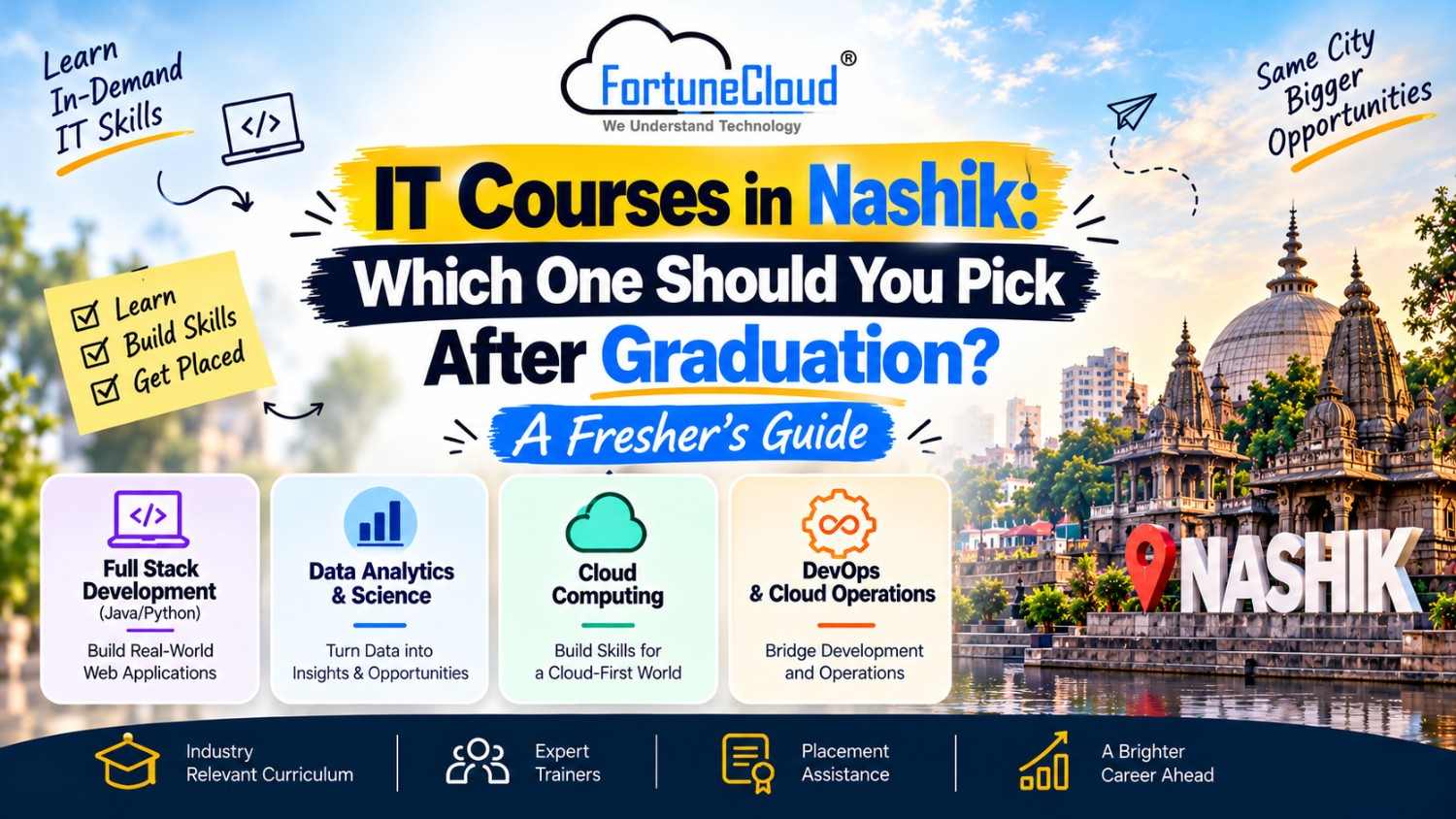
IT Courses in Nashik: Which One Should You Pick After Graduation? A Fresher’s Guide
Final year results are out, your friends are talking about job offers, and your phone is full of ads for “best IT course” promising big packages. If you are in Nashik, you may also be wondering whether you have to move to Pune or Mumbai to start a tech career.You don’t. Nashik’s IT scene is growing, remote and hybrid roles are common, and the right training can take you from graduate to interview-ready in a few months. The hard part is choosing. This guide helps you pick from the IT courses in Nashik by matching your interests to a skill track, then checking what a course should actually give you.Quick Answer: Which IT course is best for freshers in Nashik?There is no single best course. Full stack development suits people who like building things, data analytics suits those who like patterns and numbers, cloud computing suits those curious about how systems run, and AI-integrated courses add the tools every track now uses. Python is a good starting point if you have never coded. Choose by interest first, then confirm the course includes real projects, mentor feedback, and interview practice.Why Nashik Freshers Are Choosing IT CareersNashik is known for manufacturing, agriculture, and wineries, and all of these are going digital. Businesses here need people who can build software, analyse data, and manage cloud systems. At the same time, remote work lets a graduate in Nashik work for companies in Pune, Bengaluru, or abroad without relocating.Hiring has also shifted toward proof of skill. A fresher who can show two working projects and explain them clearly often does better than someone with higher marks and nothing built. That makes the choice of a software training institute in Nashik less about the name and more about how much you build while you learn.Pick the Skill Track That Matches YouDo you enjoy seeing something work on screen? Look at full stack development. You learn to build the part users see and the server and database behind it. Stacks like MERN, Java, and Python each open different doors, from startups to banks. A full stack developer course in Nashik is one of the most searched options for good reason, since nearly every business needs web applications. See the full stack development course for the topics covered.Do you like spreadsheets, patterns, and explaining what the numbers mean? Data analytics is a friendly path, especially for BCom, BSc, and other non-engineering graduates. You learn Excel, SQL, Power BI, and basic Python. Many learners now pick a data analytics course in Nashik that includes Generative AI, because analysts who use AI tools to clean data and draft queries work faster. The data analytics course with Generative AI is built around that blend.Are you curious about how apps stay online? Cloud computing and DevOps teach you to set up, secure, and automate infrastructure on platforms like AWS and Azure. Searches for a cloud computing course in Nashik and AWS training in Nashik keep growing as more companies move to the cloud. Explore the cloud computing course if this sounds like you.Do you want to start from zero? A Python course in Nashik is the gentlest on-ramp. Python leads into automation, analytics, and AI, so you keep every option open.Are you drawn to the newest area? Agentic AI covers software that plans and completes tasks with little human help. It builds on Python and basic APIs, so most students take it after the fundamentals. See the agentic AI course for details.Why AI-Integrated Courses Matter NowAI is no longer a separate career lane. Developers use AI assistants to write and debug code, analysts use them to clean data, and cloud engineers use them to write automation scripts. A course that ignores this teaches yesterday’s version of the job.So when you compare IT classes in Nashik, ask how AI is used during everyday lessons and projects, not just whether it appears on the brochure. AI-integrated courses teach your chosen track with these tools built in, which is the way employers now expect you to work.What a Good IT Course Gives YouWhichever track you choose, look for these:Hands-on projects you build yourself, not only guided demosMentors who ask “why,” so you learn to defend your choicesCurrent tools, including cloud deployment and AI assistantsInterview preparation, such as mock interviews, resume reviews, and practice explaining your projectsFlexibility, with classroom and online options for students and working peopleSearching for computer courses in Nashik or coding classes in Nashik gives you plenty of choices. These five points help you compare them fairly.How to Turn Training Into Job OffersPlacement support helps, and your own preparation decides how far it takes you. Freshers who get offers usually do these things:Build 2 or 3 real projects. A sales dashboard for a local shop or a small web app people can use works well.Put them on GitHub and online, and share a short demo video on LinkedIn.Practise a two-minute explanation: the problem, your tools, one challenge, and how you solved it.Rehearse out loud. How you talk about your work often matters as much as the work.Treat every interview as practice, noting tricky questions and improving before the next one.Students who follow this approach walk into interviews with stories, not just certificates.Why Consider Fortune Cloud Technologies in NashikIf you are building your shortlist of IT training institutes in Nashik, Fortune Cloud Technologies is worth a demo class. The institute brings over a decade of training experience to the Nashik branch:5,500+ students trained and placed5000+ hiring companies in its network94% placement rate11+ years of excellence in IT trainingCourses span full stack development, data analytics, cloud computing, and AI, with AI integrated into the learning and a focus on projects you can show in interviews. The best way to judge any institute is to visit, attend a demo, and ask your questions in person.A Simple Way to DecidePick your direction using the interest questions above.Read the syllabus, including how AI is used.Check for real projects and mentor feedback.Attend a demo class before paying fees.Start with the basics (Python if you’re a beginner), then specialise.Frequently Asked QuestionsWhich is the best IT course in Nashik for freshers? Full stack development and data analytics suit most freshers. Cloud computing and AI-integrated tracks suit those comfortable with technical concepts. Beginners can start with Python.Can non-IT graduates join IT courses in Nashik? Yes. Data analytics, Python, and software testing programs are generally open to graduates from any stream. Check eligibility with the institute.What is the best IT training institute in Nashik? It depends on your goals. Compare curriculum, projects, mentors, and interview preparation, and attend demo classes at your shortlisted institutes before deciding.Are there IT courses in Nashik with placement support? Many institutes offer placement support, including resume reviews, mock interviews, and employer connections. Ask exactly what is included for your course.How long does an IT course take? Most programs run three to six months, depending on the track and depth. Consistent practice and projects matter more than the duration alone.What is an AI-integrated IT course? It is a course where AI tools are used throughout the lessons, such as writing code with AI assistants or analysing data with AI, instead of being a separate topic at the end.Can I learn IT courses online from Nashik? Yes. Many institutes offer both classroom and live online batches. Confirm whether recorded lectures are included for revision.
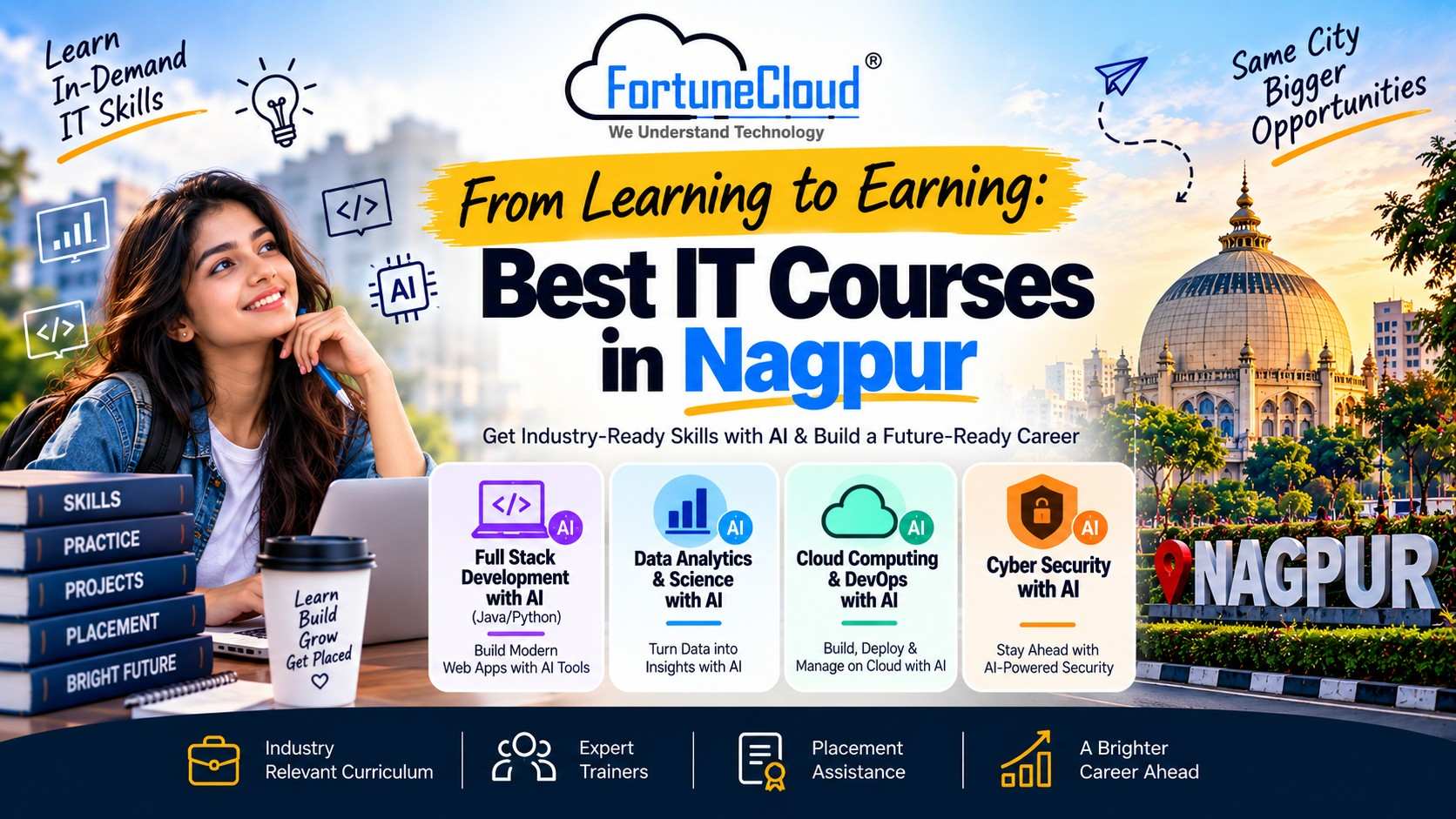
Upgrade Your Skills with Industry Ready IT Courses in Nagpur
Introduction: Your Degree Is a Start. Your Skills Move You Forward. Have you completed your graduation, started working, or realized that your current skills need an upgrade? You're not alone. The technology industry keeps evolving, and employers increasingly look for people who can apply their knowledge to practical problems, not just list tools on a resume. Choosing the right best IT training institute in Nagpur can help you build relevant technical skills, practice real world tasks and prepare for opportunities in the IT industry.The good news? You don't need to master every trending technology at once. Whether you're a fresher looking for your first job, a working professional planning a career switch, or someone returning to the workforce, the smarter approach is to identify your goal and choose training that helps you move towards it.Let's explore the IT courses worth considering, the skills employers expect, and how to make your learning more career-focused.What Makes an IT Course Industry-Ready?An industry-ready course should help you move from understanding a concept to applying it independently. Watching a trainer write code or demonstrate a dashboard is useful, but you also need opportunities to practise, make mistakes and solve problems yourself.Before enrolling, look for these important elements:Strong fundamentals: Understand programming, databases, networking, statistics or other foundations relevant to your chosen field.Hands-on practice: Complete assignments, labs and practical exercises instead of relying entirely on theory.Realistic projects: Build applications, dashboards, reports or deployment workflows that demonstrate your skills.Current tools and workflows: Learn relevant technologies, version control, debugging, documentation and responsible AI-assisted work where appropriate.Interview preparation: Practise explaining your decisions, solving technical questions and discussing your projects.Career support: Look for transparent guidance on resumes, mock interviews and relevant job opportunities.Remember, a course certificate can show that you've completed training. Your ability to explain and demonstrate what you've learned is what makes that training valuable.Best Industry-Ready IT Courses in Nagpur1. Full Stack DevelopmentInterested in building websites, web applications or software products? Full Stack Development can be a practical starting point for a career in software development.Full Stack Developers work across the front end, which users interact with, and the back end, which manages application logic, APIs and data.Key skills to learn:HTML, CSS and JavaScriptJava or Python programming fundamentalsFront-end frameworks and responsive designBack-end development and REST APIsSQL and database managementGit, debugging and deployment fundamentalsMake your learning industry-ready: Build a student management application, job portal or e-commerce project. Learn to explain how your application works, how data moves through it and how you would troubleshoot a problem.Potential career paths: Junior Software Developer, Full Stack Developer and Web Developer, depending on your skills and the role's requirements.2. Data AnalyticsBusinesses need people who can turn raw information into meaningful insights. Data Analytics focuses on collecting, cleaning, analysing and presenting data to support decisions.It's a useful option if you enjoy working with numbers, spotting patterns and understanding business performance.Key skills to learn:Excel and spreadsheet analysisSQL for retrieving and analysing dataPower BI or similar visualisation toolsPython for data analysisData cleaning and basic statisticsDashboard creation and business reportingMake your learning industry-ready: Analyse a sales dataset, create a dashboard and explain what the results reveal. For example, can you identify which products perform well, where sales are declining and what further information a business needs?Potential career paths: Junior Data Analyst, Reporting Analyst and Business Intelligence Analyst, depending on the employer's requirements.3. Data Science with Generative AIData Science combines programming, statistics and analytical techniques to discover patterns and develop predictive models. Generative AI adds capabilities for tasks such as summarisation, content generation, information retrieval and assistance with workflows.However, learning to use an AI tool is not the same as understanding how to build or evaluate a reliable data solution.Key skills to learn:Python programmingStatistics and probabilityData preparation and exploratory analysisMachine learning fundamentalsModel evaluation and interpretationGenerative AI concepts, limitations and responsible useMake your learning industry-ready: Build a small machine-learning project using a public dataset or create a simple document-question-answering prototype. Learn to test outputs, identify errors and protect sensitive information.Potential career paths: Junior Data Analyst progressing towards data science, or entry-level roles aligned with the specific skills and experience you develop. Data Scientist positions may require stronger mathematical, programming and modelling foundations.4. Cloud Computing and DevOpsModern applications need reliable infrastructure, smooth deployments and continuous monitoring. Cloud Computing and DevOps training can help you understand how applications are hosted, updated and maintained.Cloud Computing focuses on using cloud-based infrastructure and services. DevOps focuses on improving collaboration and automating software delivery and operations.Key skills to learn:Linux and command-line basicsNetworking fundamentalsCloud platforms and core servicesGit and version controlDocker and containerisationCI/CD pipelines and deployment automationMonitoring and troubleshootingMake your learning industry-ready: Deploy a simple web application, document its architecture and practise a basic deployment pipeline. Understanding how to troubleshoot failures is just as important as learning the tools.Potential career paths: Cloud Support Associate, Junior DevOps Engineer and Cloud Operations Associate, depending on your practical skills and the employer's requirements.5. Cybersecurity with Generative AIAs businesses depend on digital systems, protecting networks, applications and sensitive information becomes increasingly important. Cybersecurity training introduces you to the methods used to identify threats, reduce vulnerabilities and strengthen security.Generative AI can support certain security workflows, such as summarising alerts, assisting with documentation and helping analysts investigate information. However, AI-generated findings still need human verification.Key skills to learn:Networking and operating system fundamentalsLinux basics and security principlesCommon cyber threats and vulnerabilitiesAccess control and authenticationSecurity monitoring and incident-response conceptsAI-assisted analysis, verification and responsible data handlingMake your learning industry-ready: Practise analysing sample security logs, identifying suspicious activity in an authorised lab and documenting your findings. Understand the difference between an actual security incident and a false positive.Potential career paths: Junior Security Analyst, Security Operations Centre (SOC) Analyst Trainee and entry-level cybersecurity support roles, depending on the course and employer expectations.Important: Generative AI is a supporting capability, not a substitute for security fundamentals. Always practise security testing in authorised environments.6. Software Testing and Quality AssuranceNot everyone who works in IT needs to spend the entire day building applications. Software Testing focuses on checking whether applications work as expected and identifying issues before they affect users.This path can suit learners who are detail-oriented and enjoy investigating problems.Key skills to learn:Software testing fundamentalsTest cases and test scenariosFunctional and regression testingBug reporting and defect trackingAPI testing basicsTest automation conceptsMake your learning industry-ready: Test a sample application, prepare test cases, record reproducible bugs and explain how you would verify a fix.Potential career paths: Junior Software Tester, QA Trainee and entry-level Test Analyst.How to Choose the Right IT Course for Your Career GoalsBefore selecting a course, ask yourself what kind of work you would enjoy doing regularly.If you like creating applications, explore Full Stack Development.If you enjoy finding patterns in numbers, consider Data Analytics.If you're interested in statistics, modelling and AI, explore Data Science.If systems, infrastructure and automation interest you, consider Cloud Computing and DevOps.If digital protection and investigation appeal to you, explore Cybersecurity.If you enjoy identifying errors and checking details, consider Software Testing.Next, evaluate the training itself. Check the syllabus, practical sessions, trainer experience, project work, course duration and career support.Also, ask whether the curriculum teaches the fundamentals before introducing advanced tools. A course can mention many technologies and still leave you unprepared if you don't get enough time to practise.How to Become Job-Ready After IT TrainingJoining a course is only the beginning. Your daily learning habits will influence how much you gain from it.1. Set a clear career goalIdentify the entry-level roles you want to target and review the skills repeatedly mentioned in relevant job descriptions.2. Practise beyond classroom hoursSolve problems independently, revisit difficult concepts and use documentation to understand why something works.3. Build a project portfolioCreate two or three meaningful projects that match your chosen field. Document the problem, your approach, tools used and final outcome.4. Prepare for interviewsPractise technical questions, explain your projects aloud and improve your communication and problem-solving approach.5. Apply consistently and learn from feedbackApply for suitable internships and fresher positions, track your applications and work on the gaps revealed during interviews.Why Practical IT Training Matters in NagpurFor students and working professionals in Nagpur, the objective should be to build skills that are useful beyond the classroom. A structured learning environment can provide guidance, regular practice and feedback, while independent projects help you apply what you've learned.When evaluating a local institute, ask about its practical curriculum, trainers, project work, mock interviews and placement-support process. Check exactly what the support includes rather than assuming that course completion guarantees a job.Also consider the learning environment, commute, batch timings and flexibility if you're balancing training with college or employment. The right course is one you can complete with consistent practice and a clear plan for applying your skills.Frequently Asked Questions1. Which industry-ready IT course is best in Nagpur?Full Stack Development, Data Analytics, Data Science, Cloud Computing, DevOps, Cybersecurity and Software Testing are all options to consider. Your interests, existing skills and target job role should guide your choice.2. Can freshers join industry-ready IT courses without coding experience?Yes. Many courses are designed for beginners. Start with a programme that teaches the required fundamentals before moving to advanced concepts. Courses involving programming or data science will require regular coding practice.3. How long does it take to become job-ready?It depends on your starting level, chosen specialisation, course structure and practice time. A course may take several months, but building project experience and preparing for interviews can require additional effort. Focus on demonstrable skills rather than duration alone.4. Do industry-ready IT courses guarantee placement?No course should be assumed to guarantee employment unless its terms clearly establish a specific, verifiable commitment. Training may include placement assistance, interview preparation and employer connections, but hiring depends on several factors, including your skills and available opportunities.5. Is learning Generative AI useful for IT professionals?It can be useful across development, analytics, cloud and cybersecurity workflows. However, you should first understand the fundamentals of your chosen field. Learn to verify AI-generated results, recognise limitations and handle data responsibly.Final Thoughts: Upgrade Your Skills, Not Just Your ResumeThe IT industry offers different career paths, but progress starts with a simple decision: choose a direction and commit to learning it properly. Build strong fundamentals, practise on real-world projects and prepare to demonstrate your skills rather than relying only on certificates. If cybersecurity interests you, explore a cyber security course with gen ai to understand how security fundamentals and AI-assisted workflows can work together. With consistent effort and the right learning approach, you can take meaningful steps towards your next career opportunity.

PHP Emergency Update 2026 : How One Critical Bug Shows Which IT Skills Get You Hired
Picture a Thursday morning at a small software company. A message lands in the team chat from the lead engineer: “PHP just announced a critical fix. Everyone check what we’re running. Now.”Within an hour, the senior developers are quiet and busy. The newest person on the team, a fresher hired three months ago, is suddenly the one holding a spreadsheet of servers, trying to work out which ones need attention first. Nothing in their college syllabus covered this exact scene, yet it is one of the most common situations in real IT work.That scene played out in thousands of companies this week, after two serious flaws in the PHP language were announced and patched on October 21, 2026. The problems, tracked as CVE-2026-109618 and CVE-2026-109619 and nicknamed php2shell, drew urgent warnings because they sit in the engine that runs PHP applications rather than in any single website’s code.Quick Answer: What does the PHP2Shell incident mean for IT freshers? It is a live example of how companies respond when a core technology has a critical flaw. The work involves finding every affected system, patching quickly, watching for suspicious activity, and communicating clearly. Those tasks use cyber security, cloud, programming, data analysis, and AI skills, which is why freshers who learn them are easier to hire than those who only know syntax.Why a Bug in the Engine Is a Bigger Deal Than a Bug in One SiteMost security stories involve one app, one plugin, or one careless setting. A flaw in the runtime is different. Every site built on top of it inherits the risk, no matter how carefully its own code was written.Think of it like a defect in a building’s foundation. It doesn’t matter how well each flat is decorated. That is why the response was so broad, and why even teams that don’t consider themselves “PHP shops” had to check whether any tool or third-party app on their servers used it.Security researchers have also pointed out that AI tools are making it faster to build working attacks from weaknesses that were hard to exploit before. Whatever the exact details, the direction is clear: defenders need to move faster too, and AI-assisted work is becoming part of that.Four Jobs Hidden Inside One EmergencyIf you zoom in on that Thursday morning, you can see four different roles at work.The inventory keeper. Before anything can be fixed, someone has to know what exists: which servers, which versions, which projects. This is unglamorous and essential, and it is often handed to juniors who can write a small script to do the checking. A beginner-friendly Python programming course gives you the tools for exactly this kind of automation.The infrastructure hands. Once you know what is affected, the fix has to reach containers, virtual machines, and hosted environments, ideally without breaking anything. People who understand deployment, images, and automation make this smooth. That is the territory of a cloud computing course, and it explains why cloud and DevOps skills keep appearing in lists of in-demand fresher skills.The application owner. Developers need to know what their app depends on and whether an update could break it. A full stack development course that teaches dependencies, environments, and deployment habits trains this awareness, whatever language the stack uses.The watcher. After patching, someone reads logs and monitors behaviour to catch anything unusual. Sorting, filtering, and summarising large volumes of records is core analytics work, and a data analytics course with Generative AI shows how AI tools can speed it up.Behind all four sits the security mindset, which cyber security training develops directly: think like an attacker, prioritise by risk, and respond calmly.Where AI Fits Into This PictureTeams are starting to use AI assistants to summarise alerts, draft scripts, and explain unfamiliar error messages during incidents. That doesn’t remove the need for human judgment. It raises the bar for it, because someone still has to check whether the AI’s suggestion is right.This is why AI-integrated courses are worth a close look. They teach a track, whether development, analytics, or cloud, with AI tools used in everyday exercises rather than saved for a bonus module at the end. If you are curious about software that plans and carries out tasks with little supervision, an agentic AI course is a logical next step after Python.Is PHP Finished?No. Serious flaws appear in every widely used technology, and a fast, well-coordinated fix is a sign of a healthy ecosystem, not a dying one. The lesson isn’t “avoid PHP.” It is “don’t build a career on one tool, and learn how systems are run, protected, and repaired.”Freshers who understand that tend to adapt easily when the next headline is about a different language or platform.Turn This Into Interview MaterialHiring managers love candidates who can talk about real situations. After reading about an incident like this, try preparing a short answer to: “A critical flaw is announced in a technology our company uses. What do you do in the first two hours?”A strong answer covers four ideas: find what is affected, patch the most exposed systems first, test before and after, and tell the right people clearly. If you can say that calmly and add one example from your own project, you will stand out.Frequently Asked QuestionsWhat is PHP2Shell? It is the nickname for two critical vulnerabilities in the PHP runtime, announced and patched on October 21, 2026. They are tracked as CVE-2026-109618 and CVE-2026-109619.Do I need to learn PHP to work in security or cloud roles? No. The skills involved here, such as inventory, patching, monitoring, and secure development habits, apply to any technology.Which courses relate most closely to this kind of work? Cyber security, cloud computing, and full stack development are closest, with Python for automation and data analytics for log analysis. AI-integrated versions add the tools teams now use to work faster.How can a fresher show these skills without work experience? Build a small project that does something practical, such as a script that checks software versions across a few test machines, and explain what you learned.Where can I find reliable updates on the issue? The official PHP news page and your hosting provider’s announcements are the best sources, since details can change as the story develops.

Best IT Course for Freshers Who Don’t Know What They Like (Try This First)
Ask ten IT freshers why they chose their course, and most will say the same thing: a friend joined it, a YouTube video made it look exciting, or a salary screenshot went viral. Very few chose it because they had actually tried the work first. Then week six arrives, the topics get harder, and motivation drops, because the work was never a good match to begin with.The good news is that you don’t need to know what you like before you start. You need a small, cheap way to find out. This guide gives you one.Quick Answer: How do you choose an IT career when you don’t know what you like?Skip the guessing and run a short experiment. Spend about a week each trying a small task in three areas: building something (development), working with data (analytics), and understanding how systems run (cloud). Notice which task you lose track of time doing. Then choose a course in that direction, ideally an AI-integrated one, since AI tools now run through almost every IT role, and build two or three projects you can explain in interviews.Why “Follow Your Passion” Doesn’t Work for FreshersPassion usually comes after skill, not before it. Most people don’t feel passionate about something they have never done. What they feel instead is curiosity, or irritation, and both are useful signals.So replace “what am I passionate about?” with two easier questions:What kind of problem do I enjoy solving? Building a visible thing, finding a pattern in numbers, or keeping a system running?Which tasks make me forget to check my phone? That is the clearest sign of a match.Your answers don’t have to be permanent. Most IT careers overlap heavily in the first year, and a good foundation lets you switch lanes without starting over.The 3-Week Sampling PlanYou don’t need a course for this stage. You need a laptop, internet access, and about an hour a day.Week 1: Build something small (development flavour)Learn just enough Python to write a small program, such as a tip calculator or a quiz game. If you enjoy the moment it finally runs, development may suit you. Later, you can widen this into a full stack development course, where you build complete web applications.Week 2: Play with data (analytics flavour)Take a free dataset, such as cricket scores, a spreadsheet of your own expenses, or public sales data. Sort it, filter it, make one chart, and write two sentences about what you found. If that felt like solving a puzzle, look at a data analytics course with Generative AI. If you also enjoy the maths behind predictions, a data science course goes deeper.Week 3: Peek behind the curtain (cloud flavour)Open a free-tier cloud account, launch a small virtual machine, and put a basic web page on it. If you got curious about how apps stay online, a cloud computing course covering AWS, Azure, and DevOps is worth exploring.Keep a one-line note each day: what I did, what I enjoyed, what annoyed me. After three weeks, the pattern is usually obvious.Match What You Enjoy to an IT TrackIf you enjoy seeing something work on screen: look at Full Stack Development. Typical entry roles: Web Developer, Software Trainee.If you enjoy patterns, spreadsheets, and clear explanations: look at Data Analytics. Typical entry roles: Data Analyst, MIS Executive.If you enjoy statistics and predictions: look at Data Science. Typical entry roles: Junior Data Scientist, Analyst.If you enjoy keeping systems running and automating tasks: look at Cloud Computing and DevOps. Typical entry roles: Cloud Support Associate, DevOps Trainee.If you enjoy making software act on its own: look at AI and Agentic AI. Typical entry roles: AI Automation Engineer, AI Developer.If you enjoy spotting what’s broken: look at Software Testing. Typical entry roles: QA Engineer, Test Analyst.If you enjoy protecting systems: look at Cyber Security. Typical entry roles: Security Analyst Trainee.If two rows tempt you, start with the one that has the easier first step and keep the other as a second skill. Many strong freshers combine, for example, analytics with automation, or full stack with a little cloud.Why AI-Integrated Courses Make the Choice SaferHere is the part that makes choosing easier than it looks. AI is no longer a separate career lane that you pick or skip. It now runs through nearly every track:Developers use AI assistants to write and debug code fasterAnalysts use AI tools to clean data and draft queriesCloud engineers use AI to write automation scripts and read logsTesters use AI to generate test casesThat’s why AI-integrated courses are a sensible default. They teach your chosen track the way the work is done today, with AI tools inside the workflow, instead of adding one optional module at the end. When you compare programs, ask how AI is used during normal classes and projects, not just whether the brochure lists it. If you’re curious about the most AI-heavy path, an agentic AI course shows how software can plan and complete tasks on its own, which builds on Python and basic APIs.Five Mistakes That Waste MonthsChoosing by salary headlines. Packages vary by skill and project quality, so a number tells you little about whether you’ll enjoy the work.Copying a friend’s choice. Their strengths and interests aren’t yours.Waiting for certainty. Clarity comes from trying, not from thinking harder.Collecting certificates instead of projects. Interviewers ask what you built, so build things.Treating the first choice as permanent. Your first track is a starting point. Skills transfer more than most people expect.After You Choose: Turn Learning Into Interview StoriesOnce you commit to a direction, the goal is simple: leave your course with two or three projects you can talk about confidently.Solve a real problem. A sales dashboard for a local shop, a student helpdesk chatbot, or a small web app friends actually use.Show your work. Put the code on GitHub, deploy it if you can, and share a short demo video on LinkedIn.Practise a two-minute explanation. Cover the problem, your tools, one challenge, and how you solved it.Rehearse out loud. How you talk about your work often matters as much as the work itself, so practise with mock interviews and friends.Freshers in Pune, Nashik, Nagpur, and other Maharashtra cities who follow this approach tend to walk into interviews with far more confidence, because they are describing something they genuinely built and understood.Frequently Asked QuestionsHow do I choose an IT career if I have no idea what I like?Run a short experiment. Spend roughly a week each trying a small task in development, data, and cloud, then notice which one you enjoyed most. Choose a course in that direction and build projects to confirm it.Which IT course is best for complete beginners?Python is a gentle starting point because it feeds into development, analytics, automation, and AI. After that, pick a specialised track based on what you enjoyed during your sampling weeks.Can a non-IT or non-engineering graduate start an IT career?Yes. Data analytics, Python, and software testing are commonly open to graduates from any stream, and many beginner programs build fundamentals from scratch. Eligibility varies by institute, so confirm before enrolling.What is an AI-integrated IT course?It is a course where AI tools are used throughout the learning, such as writing code with AI assistants, analysing data with AI, or automating cloud tasks, rather than being taught as a separate topic at the end.Is it okay to switch tracks later?Yes. Foundations like Python, databases, and problem-solving carry across tracks, so a switch after the first year doesn’t mean starting from zero.How long should I explore before choosing a course?Two to four weeks of focused sampling is usually enough. More than that tends to turn into delay rather than clarity.Do projects really matter more than certificates?Certificates add credibility, but projects show what you can do. In interviews, a clear explanation of something you built usually outweighs a list of certificates.
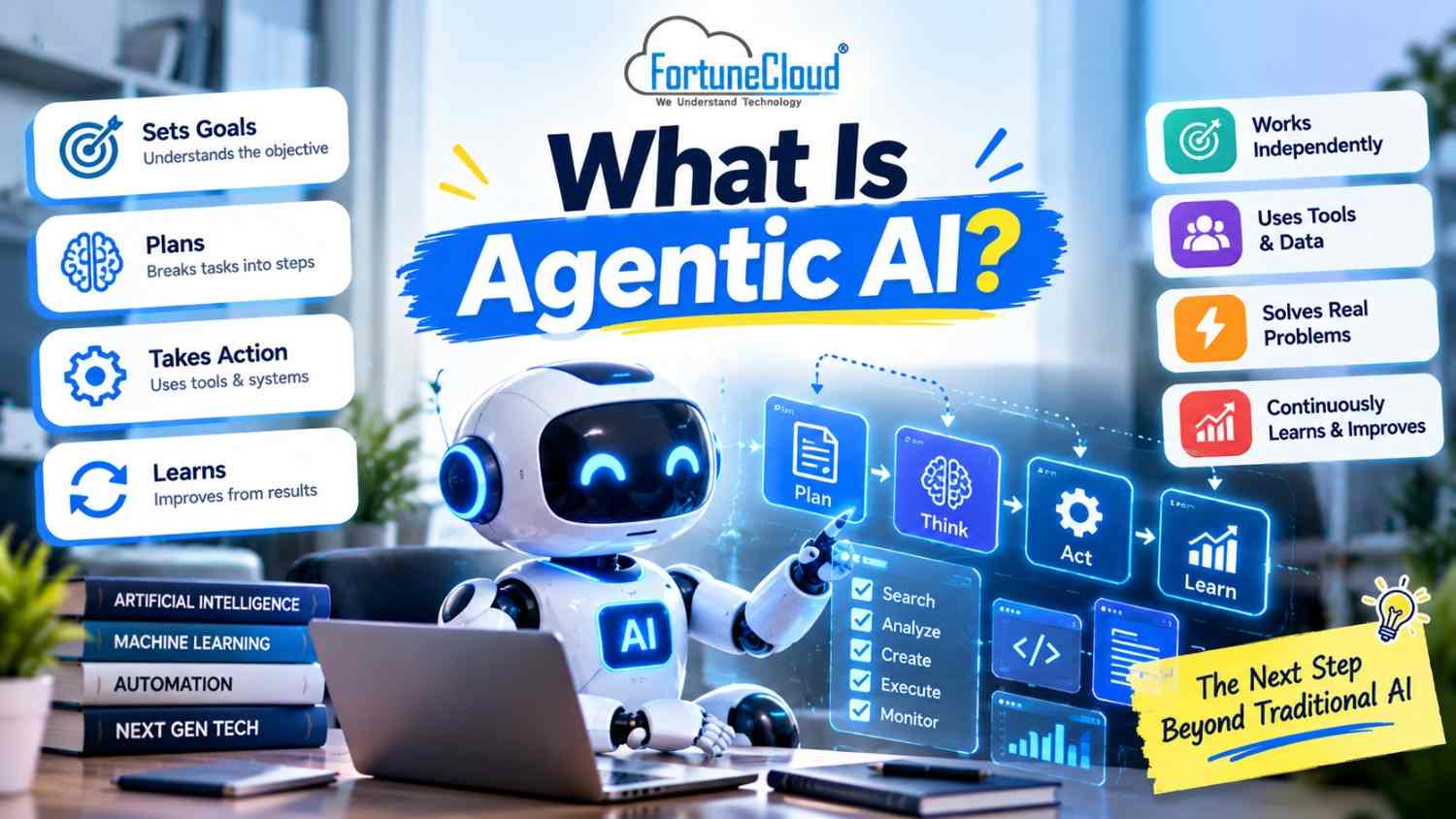
What Is Agentic AI? The Complete Fresher’s Guide to Jobs, Skills and a 90-Day Roadmap
Quick answer: Agentic AI is software that can take a goal, break it into steps, use tools such as search, databases or APIs, and finish the task with little human help. A chatbot answers your question. An AI agent gets the job done. For freshers, it is one of the fastest-growing entry points into tech in 2026, and AI-integrated courses are one of the easiest ways in, because they build agents, APIs and real projects into the learning from the start. You can begin with Python, basic APIs and one good project.Why everyone is suddenly talking about agentic AIOpen any job portal this year and you will see new titles: AI Agent Developer, LLM Application Engineer, AI Automation Engineer. These roles barely existed two years ago.The numbers explain the buzz. Gartner expects 40% of enterprise applications to include task-specific AI agents by the end of 2026, up from under 5% in 2025. In India, HR firm CIEL reports demand for agentic AI engineers up roughly 260% compared with 2025, and Naukri JobSpeak recorded 31% year-on-year growth in AI and ML hiring in August 2026.In short, companies have moved from testing AI to putting it to work. They need people who can build, connect and look after these agents. Many of those people will be freshers who learned the right skills early.Chatbot vs AI agent: the simplest way to understand itThink about planning a trip from Pune to Goa.A chatbot gives you a list of trains and hotels when you ask. You still compare, book and pay yourself.An AI agent is given the goal “book me the cheapest trip to Goa next Friday under ₹8,000”. It checks train availability, compares hotels, picks the best combination, asks you to confirm and then completes the booking.The difference is action. An agent plans, decides, uses tools and checks its own progress.How an AI agent works, in four partsYou do not need a PhD to understand the building blocks. Almost every agent has the same four parts:The brain (a large language model). Models such as GPT, Claude, Gemini or open-source Llama read the goal and reason about what to do next.Tools. Functions the agent is allowed to call: a web search, a SQL query, a payment API, an email sender. This is where your coding skills matter most.Memory. Short-term memory of the current task, plus long-term memory stored in a database (often a vector database) so the agent can recall documents and past work.The loop. The agent plans a step, acts, looks at the result and decides the next step until the goal is met or it needs a human.If you have studied full stack development, notice something: tools are just APIs, memory is just a database, and the loop is just a program. Agentic AI is built on skills you may already be learning.Can a fresher really get an agentic AI job?Yes, with a realistic plan. Here is why freshers have a genuine chance:The field is new for everyone. A developer with eight years of experience and a fresher are both learning agent frameworks for the first time. Experience gaps are smaller than in older fields.Hiring is skill-first. Indian employers increasingly shortlist on projects and GitHub work rather than college name alone, which helps students from Tier-2 cities too.Startups hire fast. AI-first startups and service companies building agents for clients often hire freshers sooner than large enterprises do.What recruiters will not accept is buzzwords without proof. Placement trainers note that recruiters now test AI literacy directly, for example asking a candidate to spot when a model has given a confident but wrong answer. Build things and be able to explain them.Salary snapshot: Fresher salaries for agentic AI roles in India typically fall between ₹4 LPA and ₹12 LPA. Your project portfolio and internship experience move you up that range far more than your degree does.The skills you actually needForget long lists. Focus on these six, in this order.Python. The default language for AI. Learn functions, classes, error handling and working with JSON.APIs. Know how to call a REST API and how to build a small one with FastAPI, Flask or Node.js. Agents live on APIs.LLM basics and prompting. Understand tokens, context windows, system prompts and why models hallucinate.An agent framework. Pick one: LangChain/LangGraph, CrewAI or an official provider SDK. Learn one well before trying others.Data and retrieval. SQL, plus the idea of embeddings and a vector database such as Chroma or Pinecone for RAG.Cloud deployment. Put your agent online using AWS, Azure or GCP so a recruiter can click and try it.Add two human skills: clear communication, because you will explain agent behaviour to non-technical people, and critical thinking, because you must judge when an AI output is wrong.Your 90-day agentic AI roadmapDays 1–30: FoundationsWeek 1–2: Python fundamentals and Git/GitHub.Week 3: REST APIs, JSON and calling a public API.Week 4: Call an LLM API from Python and build a simple command-line assistant.Days 31–60: Build real agentsLearn one agent framework and give your agent two or three tools (search, calculator, a database).Build a RAG app that answers questions from a set of PDFs, such as your college syllabus.Learn basic SQL and connect your agent to a small database.If you learn better with structure and mentor feedback, a guided AI-integrated agentic AI course can shorten this stage.Days 61–90: Ship and get noticedDeploy one agent on the cloud with a simple web front end.Write a README for each project explaining the problem, the tools and what you would improve.Share a short demo video on LinkedIn and apply to 5–10 roles every week.Three portfolio projects that impress recruitersCollege Helpdesk Agent. Answers student questions from the prospectus and timetable, and emails the office when it cannot answer.Job Hunt Agent. Reads job descriptions, compares them with your resume and suggests the skills to improve for each role.Small Business Sales Analyst. Takes a shop’s monthly sales Excel file, writes the SQL, finds the top products and drafts a one-page report. Local Pune businesses are perfect test users.One working, deployed project beats ten unfinished tutorials.Common mistakes freshers makeSkipping Python fundamentals and jumping straight to frameworks. Frameworks change; fundamentals do not.Collecting certificates instead of projects. Certificates help, but recruiters want something they can see working.Trusting AI output blindly. Always test what your agent produces. Showing that you check its work is itself a hireable skill.Learning alone. Join communities, attend meetups and get your code reviewed.Agentic AI connects to every tech careerYou do not have to choose between AI and your current track. A full stack developer adds agent features to apps. A cloud engineer deploys and scales agents. A data analyst uses agents to work faster. Agentic AI is becoming a layer on top of every role, which is why learning it now pays off whichever path you take.Where to start this weekYou don’t need to wait for the perfect course or the perfect laptop. Pick one small task you do repeatedly, such as summarising notes or checking a spreadsheet, and try to automate it with a simple agent. Get it working, write down what broke, and fix it. That single loop of build, break and fix teaches more than weeks of passive watching, and it gives you something real to talk about in your first interview.Frequently asked questionsWhat is agentic AI in simple words? Agentic AI is AI that can complete a task on its own. You give it a goal, and it plans the steps, uses tools and finishes the work, checking with you only when needed.Is agentic AI different from generative AI? Yes. Generative AI creates content such as text or images when prompted. Agentic AI uses generative models as its brain but goes further by taking actions toward a goal.What is an AI-integrated agentic AI course? It is a course where AI tools are part of the daily learning workflow, from writing code with AI assistants to building and testing agents, instead of being taught as a separate topic at the end.Can a non-CS or BCom student learn agentic AI? Yes. Start with Python and logic building. Roles like AI automation and AI data analysis are open to graduates from any stream who build solid projects.How long does it take a fresher to learn agentic AI? With 2–3 hours of daily practice, most freshers can build and deploy a basic agent in about three months. Job-ready depth usually takes four to six months.Which programming language is best for agentic AI? Python is the best first choice. JavaScript or TypeScript is useful if you want to build AI features into web applications.What is the salary of an agentic AI fresher in India? Most fresher offers fall between ₹4 LPA and ₹12 LPA, depending on projects, internships and the company.Will agentic AI take away developer jobs? It changes jobs more than it removes them. Companies still need people to design, build, test and supervise agents, and those roles are growing.
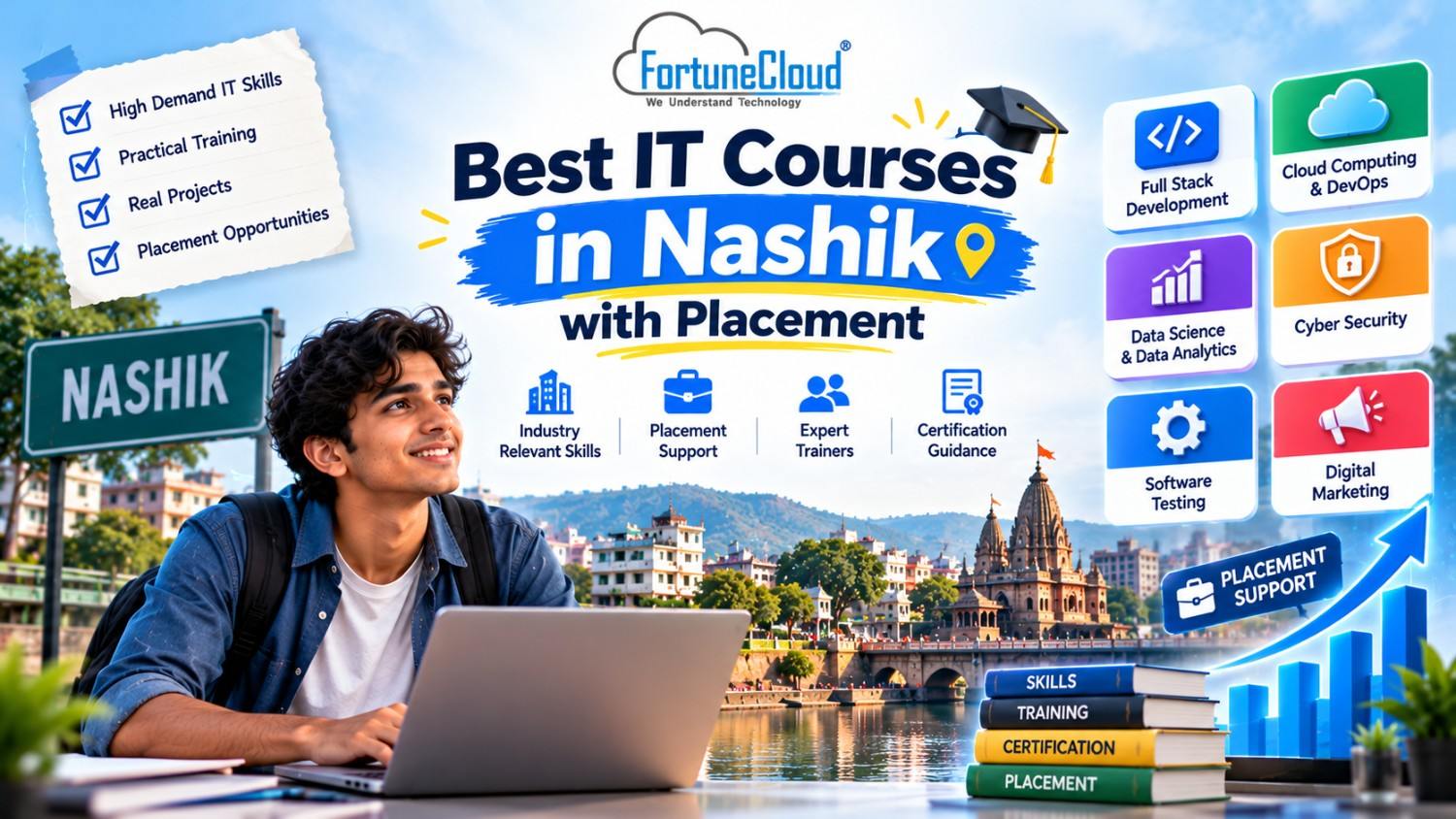
Best IT Courses in Nashik with Placement: What Freshers Should Study Before Choosing One
Quick answer: The best AI-integrated IT courses in Nashik with placement for freshers are Full Stack Development, Data Analytics, Cloud Computing with DevOps, and AI with Agentic AI. Beginners with no coding background can start with Python. Pick the track that matches your degree and interests, then build real projects along the way, because those projects are what you will talk about in your interviews.Why Nashik Is Now a Real Option for Starting an IT CareerA few years ago, most Nashik graduates assumed a tech career meant moving to Pune, Mumbai, or Bengaluru. That is changing. Local IT companies and startups are hiring, and remote or hybrid roles let a graduate here work for employers in other cities without relocating.Hiring has also changed in what it rewards. Employers care less about where you studied and more about what you can show. A fresher with two working projects and clear answers in an interview often gets ahead of a candidate with higher marks and nothing built. That is why the course you choose, and how practical it is, matters more than the name on the certificate.1. Full Stack Development (AI Integrated) Full stack developers build the part of an application users see and the server and database behind it. It stays one of the most flexible tracks because almost every business needs web applications.The tech stack you choose shapes where you can aim. MERN suits students who enjoy JavaScript and want startup roles. Java full stack points toward large service companies and banks. Python full stack keeps an easy path into AI open. Recruiters also now expect freshers to know how to add a simple AI feature, such as a chatbot or smart search, to an app. If you like seeing something working on screen, a full stack development course is a strong place to start.2. Data Analytics with Gen AIManufacturers, retailers, wineries, and service companies in and around Nashik all collect data, and analysts turn it into reports that guide decisions. Because the work depends more on logic and curiosity than heavy programming, this is often the most accessible track for non-engineering graduates.You will typically learn Excel, SQL, Power BI or Tableau, and basic Python. Analysts who use AI tools to clean data and draft queries faster are increasingly preferred, which is why many learners choose a data analytics course with Generative AI rather than a purely traditional one.3. Cloud Computing and DevOps (AI Integrated)Companies keep moving their software to AWS, Azure, and Google Cloud, and they need people to set up, secure, and automate that infrastructure. Cloud and DevOps appear regularly among the higher-paying fresher skills, and a recognised certification such as AWS Cloud Practitioner or Azure Fundamentals strengthens a resume.This track suits students who wonder how applications stay online under heavy traffic. A hands-on cloud computing course covering Linux, networking, deployment, and automation gives you something concrete to show in interviews.4. AI and Agentic AIAI is the fastest-growing area in tech. Agentic AI, where software plans and completes tasks with little human help, has created entry-level roles that barely existed two years ago. A good fresher program starts with Python and builds toward real projects, such as a document question-and-answer assistant or a task-automation agent. If this interests you, an Agentic AI course is the natural next step once your Python basics are solid.Starting From Zero? Begin With PythonIf you have never written code, jumping straight into a specialised track can feel overwhelming. A beginner-friendly Python programming course is a lower-pressure start, and it feeds into analytics, automation, and AI later, so you keep every option open while you figure out what you enjoy.What Fresher Salaries Look LikeMost IT fresher packages begin around ₹3 LPA to ₹6 LPA, with AI and cloud roles often higher for candidates who have strong projects. Your offer depends far more on your skills, portfolio, and interview performance than on the name of the course you took.How Placement Really Works: Your Projects Do the TalkingPlacement support opens doors, but the interview is where you walk through them, and that part is yours. Here is how freshers turn training into offers.1. Build projects that solve a real problem. A sales dashboard for a local shop, a student helpdesk chatbot, or a small web app that people can actually use. Real problems make better stories than copied tutorials.2. Showcase your work where recruiters can see it. Put your code on GitHub, deploy your project online, and add a short demo video to your LinkedIn profile. When a recruiter can click and try your work, you stand out immediately.3. Learn to explain your project in two minutes. Cover the problem, the tools you chose, one challenge you hit, and how you solved it. Interviewers remember a clear story far longer than a list of technologies.4. Practise how you talk, not just what you know. Confident communication often decides the outcome between two equally skilled candidates. Rehearse with mock interviews, record yourself, and ask friends to question your choices.5. Be honest about what you learned. Saying “this didn’t work at first, and here’s how I fixed it” shows real hands-on experience, and interviewers value it highly.6. Keep applying and keep improving. Treat every interview as practice. Note the questions you found tricky, work on them, and walk into the next one stronger.Resume reviews, mock interviews, and introductions to hiring companies from your institute all help. Combined with a strong project portfolio and clear communication, they put you in the best position to turn interview calls into offers.Start Your IT Career in NashikThe right course can turn a degree into a career within a few months of focused work. If you want help narrowing it down, Fortune Cloud’s Nashik branch offers free counselling and demo sessions where you can match a course to your degree and goals.Frequently Asked QuestionsWhich is the best IT course in Nashik with placement for freshers? Full Stack Development and Data Analytics are good starting points for most freshers. Choose Cloud Computing or AI if you are comfortable with technical concepts and want higher-growth roles.Can a non-IT or BCom graduate join an IT course in Nashik? Yes. Data Analytics, Software Testing, and Python programs are generally open to graduates from any stream, though eligibility can vary by institute.How long does it take to get a job after an IT course? Most courses run three to six months. Students who build projects and practise interviews seriously often start getting interview calls during or soon after the course.What is the fee for IT courses in Nashik? Fees depend on the course, duration, and mode of learning. Contact the institute for current fees, batch dates, and any EMI or scholarship options.Are online IT courses available in Nashik? Many institutes offer both classroom and live online batches. Confirm whether recorded lectures are included, so you can revise topics later.Which IT course has the highest salary in 2026? AI, Agentic AI, and Cloud or DevOps roles generally offer the highest fresher packages, followed by Full Stack Development, though individual offers vary.
Get The Latest Tech Updates Delivered.
Stay ahead of the curve with our weekly newsletter featuring exclusive insights, tutorials, and career tips from top industry veterans.
Topics You'll Love
AI, Career & Future